Saturday, 30 July 2011

Top Five MegaDrive Soundtracks

Video game music is a pretty big deal these days. Since computers and consoles starting using CD's to store their data, composers have been able to do pretty much anything they want, and the result has seen some games having orchestral soundtracks to rival those of top Hollywood blockbusters. Prior to the mid-90's, however, composers were restricted to the abilities of the system's sound chip.

This 'chiptune' music now has a cult following amongst retro gamers like myself, with some talented individuals continuing to make these primitive chips sing like never before! I am regretfully not skilled enough to create my own but I was and remain a big fan. Each major computer and console uses a different chip to produce this music so each has developed its own style.

I suppose which system we enjoy listening to the most now depends on which one we spent most time with growing up. After all, at least part of the appeal of any aspect of retro gaming is nostalgia. For me, that means the music produced on the MegaDrive / Genesis is generally my favourite. There are dozens of games whose music I still enjoy listening to on this great console, so it's been a pretty tough job, but here are the five games that I feel have the best overall soundtracks:

5 - Wiz 'n' Liz by Raising Hell Software

This underrated platformer has a very distinctive musical style... actually, it has a distinctive everything style, but this superb soundtrack by Matt Furniss is certainly among them! It has a lot of tunes including one for the each area. This one for 'Snow Land' is my favourite:


4 - Revenge of Shinobi by Sega

As the first game I played on a 16-bit console, it was the music more than the graphics of this Sega classic which best demonstrated to me the increase in power the MegaDrive held over its predecessor. It was also this soundtrack which brought now-legendary composer, Yuzo Koshiro, to prominence. It comprises over fifteen tracks, all of which are great, but this one still holds the most sway over me:


3 - Sonic the Hedgehog 2 by Sega

The first Sonic game had a great soundtrack itself but this sequel improved on its forebear in every way including musically! Most of its many tunes, by Japanese musician, Masato Nakamura, are fantastic, but I think the 'Chemical Plant' one is my favourite:


2 - Streets of Rage 2 by Sega

Many Mega Drive fans bet for the number one spot I'm sure! It would've been a worthy choice too. Another of Yuzo Koshiro's masterpieces on a console which really seemed to suit his style. I first heard this dance music style soundtrack when a friend played a recording of it on his cassette player and I mistook it for actual nightclub dance music! There can't be much more of a testament to its high quality than that! There are many stand-out tracks but I think this is my favourite:


1 - Thunder Force 3 by Techno Soft

I still regard this amazing soundtrack, by Toshiharu Yamanishi and Tomomi Ohtani as the one of the best I've ever heard, and certainly the best I've heard in a shmup. Few games make me want to play them just to hear their music! Okay, it doesn't hurt that it's a blinding game as well, but still! Every stage's tune is of the highest quality and perfectly suits the equally impressive stages themselves. There's even not one but two ending tunes too, but this track from the fourth stage just wins by a whisker:


Special Note: I didn't record these great tunes myself, I'm just an admirer, so all credit to, firstly the original composers, and secondly, the YouTube users who uploaded them!

Friday, 29 July 2011

Splendid Amiga Music #1

Datastorm (1989)

After my accidentally-enormous previous post here, I thought it might be a good idea to make a slightly shorter post this time, and what better way to do that than to extol the virtues of some great game music!? In the first post of this nature I'll remind you of (or reveal to you) the fantastic intro music to this classic Defender / Dropzone clone for the Amiga, composed by Timm Engels. Sadly, it constitutes the entire musical content of the game (to my knowledge) but remains one of my very favourite Amiga tunes. See what you think:


Wednesday, 27 July 2011

F-Zero Series - Part 6

F-Zero GX (2003)
By: Amusement Vision / Nintendo Genre: Racing Players: 1-4 Difficulty: Medium
Featured Version: Nintendo GameCube
Also Available For: Arcade


It's hard to say for sure what the most popular F-Zero game is, but for a good few, including me, it's F-Zero X. It truly was, and still is, an absolutely phenomenal racing game, and a rare recipient of a 10/10 score here at this very blog. If there's possibly one thing about it that could be improved though, most would agree that it's the graphics. Super-fast they may be, but they are also largely devoid of detail, especially the backgrounds. It seems Nintendo listened to this slight criticism of their otherwise flawless game, for when the series returned to their main console (accompanied by an arcade counterpart) after a brief GameBoy-related diversion, it was in this area of the game that they sought to impress, and they enlisted some help.

That help came from their one-time enemy, Sega. More specifically, their sub-division, Amusement Vision, formerly AM4. With this in mind, and considering that Nintendo's main console was now the GameCube, it was a mouth-watering prospect. Armed with the power of this flashy new console, the combination of Nintendo and Sega's collective genius couldn't possibly let us down, surely? That was my sincere hope and belief and the screenshots looks extremely promising when they started to emerge. Then I saw the first review, in the generally very trustworthy 'GamesTM' magazine, and it was a very good one. My excitement level rose. I immediately bought it the minute it came out. The anticipation of its release was actually the main reason I bought a GameCube to begin with. It would be worth it though, surely?

Aside from the predicted aesthetic enhancements, everything appears to be just as expected. The number of options on the menu screen is fairly exhaustive with play-modes including the usual Grand Prix, multi-player Battle (for up to four players again), Time Attack, and this time there's also a Story mode which sees you assume the role of Captain Falcon for a few 'missions'. It's also possible to view replays here, customise your machines, adjust in-game settings, and look at pilot profiles, and there is once again a handy practise mode with adjustable race and opponent settings. Unless you have any friends handy, however, it's likely that the grand prix mode will again dominate your time here.

The Grand Prix mode is divided into several 'Cups' as always. Instead of the usual playing cards, however, it is instead gemstones that give them their names - Ruby, Sapphire, Emerald, and Diamond (and another secret unlockable one too!). Most of the details are the same as F-Zero X - there's thirty competitors (including your chosen racer) who race three laps each of five circuits, gaining points (or not) based on their finishing positions. Each Cup can be raced over three difficulty levels - novice, standard, and expert - with the super-hard 'master' level also becoming available when the previous ones have been beaten. All the characters and their respective 'machines' return from the previous game too. This time there are only five (including the four from the SNES original) that can be selected from the start with the rest being unlocked as you progress through the game. Okay, so far so good.

The courses themselves are a great mixture here too. If anything they're even crazier than those found in F-Zero X. Most of them once again look like space-age roller-coasters with huge loops, banked turns, split tracks, corkscrews, tunnels, massive jumps, right-hand turns, half-pipes, track through the inside as well as over the outside of pipes, and parts at all sorts of gravity-defying angles. They're not generally as 'themed' as those found in the other games with most of them simply looking as though they've been constructed in and around futuristic cities. Many parts of the track surfaces are transparent which can be quite disorientating when they're high up in the clouds! There's also all sorts of neon lights and giant advertisements and that kind of thing around the city-based courses. Some others are located in more distinctive locations, however.

Sand Ocean is once again a set over a desert (including giant sand worms!) and there's some bits of greenery here and there on some courses. The Big Blue course even goes through underwater tunnels! You won't get to spend too much time ogling this new-found eye-candy though as the racing action is just as fast as before. The courses include lots of 'dash plates' and your machine can still produce its own boost power too (with the amount depending on the machine chosen) which reduces your energy, so it must be used carefully. There are some fairly sizeable recharge zones although they sometimes lie on one part of a split track, and a few other features like gravelly slow-down patches and energy-sapping mines. Some of the larger jumps even include several parts of track you can land on. The better your jump, the better the part of track you can land on.

I know what you may or may not be thinking - it all sounds great so far but what new stuff is there? The biggest additions are the custom machines. Here, it's possible to build your own machine using a variety of parts available in the 'garage'. New parts are unlocked by gaining tickets which are earned from time spent playing the game. The better you do, the more tickets you receive in one go. You can even decorate the outside of your machine with the Emblem Editor. Another big addition is the Story mode which sees you, as Captain Falcon, attempting to achieve set objectives such as collecting a set number of capsules, beat an opponent on an obstacle-strewn course, escape from an exploding power-plant, etc.

There's a few other new but perhaps less immediately obvious touches, of course. For example, upon successful completion of a Cup competition, you can interview... ummm... yourself, using Mr. Zero, the F-Zero Reporter, which gives a bit more character to some of the racers and there are now CGI intros, endings, and cut-scenes which flesh-out the characters, the competition, and background to the game universe in general. As expected, it's this kind of thing which sees the most noticeable improvement over F-Zero X. The presentation here really is of the highest order. The title screen and attract mode are the same thing and it's been really well done. All of the menus and options screens and what have you are simple and well-designed.

In-game, the graphics are nothing short of jaw-dropping. The biggest failing of F-Zero X was the rather uninspiring backgrounds but here they are packed with a huge amount of detail. There's far too much for me to relay here but at times there's almost too much to see - I've certainly been distracted a few times and crashed as a result! The underrated power of the GameCube flings all the courses around at lighting speeds too. The sense of speed is incredible at times, and it is maintained without exception while the whole time showing superb details in everything from the machines themselves (complete with transparent cockpits through which you can see the pilots) right down to the different types of track surface which ranges from traditional-looking tarmac to various types of metal grating to transparent materials.

As well as melting your eyes with its super-fast, neon graphics, F-Zero GX is also adept at pounding your eardrums unlike any other game. Although the fantastic soundtrack of its predecessor hardly necessitated change, the music here has undergone the same evolutionary process as the graphics. Gone are the pounding metal guitars and drums to be replaced by... well, a mixture of styles really, but the predominant one is techno/trance. It suits the game pretty well in truth and the old style metal tunes make the odd appearance (my favourite racer, Bio Rex, has one for his theme, for instance). The crazy course designs started by F-Zero X are even more extravagant here but that's not necessarily a good thing. For example, the angle of the track sometimes changes so abruptly that you can't even see where to go! Trial and error fixes this problem of course, but it's hardly the mark of a well-designed game.

The machines are much less grippy around the tracks too, slipping and sliding around all over the place, which means this game loses one of my favourite things about its prequel, namely the extremely precise control you have over your machine. Of course, with a great deal more effort you may be able to exert a greater level of control here but it's so fiddly and you'd lose so much time messing around with it that you wouldn't win many races. Given the large variety of machines, it's likely you'll find one or two that suit your racing style, but the excitement of flying round a long corner at 1000kph knowing that you're right on the edge, pushing your machine to the limit, and that if you push any harder the grip could give way any second and see you careering into the barriers, is sadly gone.

My biggest problem with the game, though, is the dilution of the actual racing. That was my absolute favourite thing about the amazing F-Zero X. It wasn't just a pulse-racing, adrenaline-rush of an experience. It was also the purest, most finely tuned actual racing game I've ever played. The controls were perfect, the courses were each masterpieces of design, and racing against twenty-nine other racers through them all was a massively immersive experience. You could see the track ahead of you, the neat graphics allowed you to identify each racer from far away, you could weave in and out of them as you made you way through the field, or you could smash into a racer you dislike. The sense of competition it conveyed was amazing. With F-Zero GX, much of that is gone and has been replaced with a flashy, super-fast arcade-style racing game much like so many others if you can look past its exterior.

F-Zero X rewarded skillful racing. Unfortunately, the bottom line is that F-Zero GX does not. Here, you can do pretty much whatever you feel like within reason for the first two laps, conserving your energy, then just boost all the way around the last lap and you'll win! Again, this is hardly befitting the sequel to such an amazing racing game. Looking at screenshots, and especially watching videos of the game, I have to admit - it looks amazing. Almost anyone would want to play it from watching just a quick demo and a vast majority would greatly enjoy doing so, particularly if they're not hopelessly devoted to F-Zero X as I am. Lord knows, this game has certainly got its fans, quite a few of them in fact. Some people think it's the best racing game ever, but I'm confident these people are either graphics tarts, or simply haven't played F-Zero X which is such a superior racing game.

There's no doubt that this really is a thrilling game with all sorts of tricks and flashy course features and special effects and is great fun for the odd blast around one of the crazy, gravity-defying tracks, but despite all the play-modes it doesn't have the depth or sheer competitiveness of its predecessor. It's still a good game, and better than most other racing games available, but it has lost the vital spark which made F-Zero X so amazing. With such a great game to build on, and with the possibilities the power of the GameCube offered, it's unfortunately a real disappointment - improved in every way except where it counted most. When I first loaded the game, seeing the Nintendo and Sega logos on the screen together was fantastic - I'd hoped for this for a long time! Sadly, inexplicably, they let me down.

RKS Score: 7/10

Tuesday, 26 July 2011

Exploring the Neo Geo - Part 1

Back at the very beginning of the 90's, I was a very proud MegaDrive owner. It was the newest and most powerful console ever at that point and I was happy to point this out to anyone who cared enough to listen, and indeed many who couldn't care less. I was in this privileged position for only a short while, however, when I started seeing reports of a new console by some company called SNK. Who the hell were they? Ohhh yeah, now I think about it, weren't they the company behind a few arcade hits like Vanguard and Ikari Warriors? Very impressive, but releasing a few arcade games is one thing, releasing an entire home console system is another thing entirely. I thought the days when any old upstart could (or rather, would) release a new format were long gone, and here was this medium-sized arcade company throwing their hat in the ring. They couldn't possibly pull it off, could they?

It turned out that they meant business! In the kind of move that would make or break the company, they first released their flashy new hardware in the arcades with the MVS (Multi Video System) which was an arcade machine built to a standard configuration and which could be fitted with up to six different games. Following swiftly on from this was the AES (Advanced Entertainment System), the immense home console version of the arcade hardware. The hardware was based on a Motorola 68000 CPU and a Zilog Z80 co-processor which was the same as that used by the MegaDrive. SNK's machine, however, was packed with lots of custom chips which gave it a lot more power than Sega's machine, or indeed some of the consoles that came after it. The games released for the system was direct ports of their arcade counterparts. If any proof was needed of their authenticity, it was possible to buy a memory card, use it at home, save your position in a game, take the memory card to your local arcade, and continue playing there. Impressive stuff!

Sounds like it was too good to be true. Well, there was two drawbacks to the system. Firstly, by its very nature it only featured conversions of SNK's own arcade games. No ports from other company's games here! The other drawback was the the enormous price of both the console and its games. Each release cost well over £100 with some games costing more than double that. Clearly this was a serious console for serious gamers. The Neo Geo quickly gained a cult following which led to its reputation for being the 'true hardcore gamers machine'. This reputation, of course, mainly comes from the assumption that only truly dedicated gamers would yield to the high price-point of the games, but it's also a reputation earned because of the games themselves which were generally very tough, but of a consistently high quality.

That's enough history though, on to the point of this post. I personally have never had the kind of money that would allow me to become a Neo Geo owner so I haven't played many of the games found on the system. Due to the huge size of the cartridges the system used, its games got ever larger and more impressive. For this post, however, I'll focus on the first few games released for it to see if they really were better than those available on my beloved MegaDrive.

NAM-1975 (1990)

I thought I'd start with this game which was apparently the first ever game released on the Neo Geo hardware. It's also a game I'm reasonably familiar with having given it a bash in its splendid two-player mode with my good friend Luke many years ago. Returning to it now, I'm pleased to see it's not aged much. Using the backdrop of the titular war, NAM-1975 is a 'shooting gallery' type game similar to Operation Wolf, but is played from a third-person viewpoint rather than first-person one more familiar to fans of Taito's classic. There's a canal or river or something that separates the hordes of enemy troops from your players who can run left and right along the bottom of the screen while shooting and lobbing their grenades but it's still a damn tough game. It's also great fun though, especially when played with a friend, and was a promising start for SNK's new hardware.

Riding Hero (1990)

Now this is a rarity - an into-the-screen racing game! I suppose it wouldn't have seemed so special in its day as it was also one of the first games released on the system but, oddly, no other games of this type would see the light of day on the Neo Geo as far as I know. It's therefore a great shame that the clots didn't make their sole effort a good one! It's a motorcycle racing game very much in the vein of Hang On which probably looks pretty good from screenshots. The graphics and sound aren't too bad and the presentation is great, but the game's main problem is a big one - the AI here overwhelmingly favours the CPU riders. I know this is the case with many racing games, especially older ones, but it's particularly annoying here. Your opponents are faster, more manoeuvrable, never crash, and cause you to crash often. An extremely frustrating game which made me very angry. Grrrr!

Cyber-Lip (1990)

I've heard the name of this one a few times but I didn't really know much about it until now. My first impressions of it, however, were great! It's a run 'n' gunner and appears to be the precursor of the celebrated Metal Slug series. The story involves a malfunctioning military computer and an out-of-control army of cyborg soldiers or some such nonsense but the important thing is, it's good! It features several stages of multi-tiered side-scrolling landscapes teeming with lots of different enemies, mid-bosses, and of course ending with giant bosses, and there's some great weapons to shoot them all with. It's not without its faults but Cyber-Lip is an addictive and nicely-paced blastathon which I really enjoyed.

Joy Joy Kid a.k.a. Puzzled (1990)

I suppose even the mightiest console needs a Tetris clone and this one is so close to the Russian classic, it might as well have carried the name! The only real innovation here is that each stage features a balloon-like character which is trapped beneath an existing arrangement of blocks. Your job is to remove a sufficient number of blocks to allow it to escape and float away. Despite this and a few other quirky features, it's not as great as the original, but it's still enjoyable and does provide a nice break from the hyper fighting and shooting games that dominate the Neo Geo library. That said, it is surprisingly unflashy for a game born in the arcades, even if it is a puzzle game, and could quite comfortably be duplicated on my MegaDrive.

Magician Lord (1990)

I remember playing this one briefly in its native environment and it's always lingered in the back of my mind as a game I'd love to own the home version of. Playing it again now reminds me why! It's a bit rough around the edges in some areas - the animation of the main character for one thing - but aside from that it's one of the best looking of the 'first generation' games with some nice colours and lovely backgrounds, and the music is great too. Gameplay-wise, like many arcade games it's tough going, but the platform 'n' ladder stages are nicely varied and the protagonist's ability to change into other forms with different abilities mixes things up well. My long-held affection for this title has been justified!

The Neo Geo launch line-up is often cited as being one of the best and these five games certainly don't harm that stance! A nice mix of genres and, aside from Riding Hero, all at least pretty good! The next part of this post will feature five more of the earliest releases for this Leviathan of a console. Who knows, I might even get around to looking at an example of the one-on-one fighting games that the system became so famous for! Stay tuned! :)

Exploring the Neo Geo Part 2

Saturday, 23 July 2011

Crap Games #3

Ace of Aces (1990)
By: Artech Digital Entertainment / US Gold Genre: Simulation Players: 1 Difficulty: Medium
Featured Version: Sega Master System
Also Available For: Atari 7800, Atari 8-bit, PC, MSX, Commodore 64, Amstrad CPC, ZX Spectrum


The two games I've covered for this feature so far have been pretty stinky and they were both stricken with bad reviews in their day but neither received such a shockingly awful score as to fill me with the kind of unbridled fear that might be felt when surrounded by hungry zombies. This poor old Master System game did. I forget the exact magazine in question now but I do have a distinct memory of this game receiving a score of 15%. Considering that most game magazines had (and still have) a tendency to rate games on a scale of 50 - 100%, with average games receiving around 75%, a score as low as 15% was a real shock. Can any game really be that bad? Considering I actually quite enjoyed this game on my Speccy (albeit briefly), I'm very interested in finding out...

Actually, this game has the possibly dubious pleasure of being the first 'flight sim' reviewed here at Red Parsley, and on paper it sounds good. You play the part of a combat pilot in command of a Hobson FB-61 fighter (which I believe is fictional) during the Second World War. You have four missions which include dog-fights with enemy bombers, taking down V-1 bombs, stopping munitions trains, and bombing U-Boats, and they can be tackled in any order you like. Before each mission you'll get a short briefing which includes the approximate position of your target, the type of weapons you'll have access to, and the weather conditions, and you'll have to load your plane with ammo and fuel before you take off.

The ammo comes in the form of bombs, rockets, and cannon rounds, and you can choose how much you want of each. Once you're in the air, you can switch between four views - straight ahead looking out of the cockpit which is obviously where you control the plane from, left or right over each wing which is where you can alter speed and twiddle several other knobs, or below where you can view your weapon inventory and, when the situation requires it, open the hatch and drop bombs. You can also refer to a map of the relevant area at any time. As I said, it all sounds pretty good on paper (or writing on screen). The prospect of controlling a lone Allied fighter over Nazi-occupied France, hunting down the heinous enemies, and doing your bit for King and country sounds pretty appealing, and the game promises the kind of depth that few Master System games of this type offer.

Unfortunately however, as the aforementioned magazine indicated with its rather harsh score, it's not been executed in a particularly skilful manner. The first problem is the supremely repetitive graphics which primarily consist of a perpetual blanket of white and grey clouds. With no points of reference on the landscape and with an immensely slow sense of speed (not to mention ultra-jerky scrolling), this can be a very boring game for the sometimes-long periods spent searching for things to shoot at, and it can also make finding them tricky too. The presentation screens are pretty good though and most of them have short ditties. These screens are the only ones with music however, as the game is nearly silent save for the constant hum of the plane's engines (which you can accidentally stall as I discovered, so be careful!).

I also initially liked the different views of the plane. It's a nice novelty to start with, but in practise it doesn't really work very well. It's far too fiddly switching from one screen to another adjusting various switches, and in the heat of battle it's not realistic to even try. Sometimes you won't even know you're in a battle until it's too late. For example, one minute you could be rummaging around in your basement, organising your missiles and the like, and then suddenly there's a funny noise, a bit of shaking, and you've shot down! Control of the plane is very sluggish as well. Just taking on an enemy fighter is a painstaking chore - trying to keep the enemy in your sights feels like you're trying to heave a 747 around!

Oh well, at least we were given ample warning. Ace of Aces has some great ideas but it, and especially this version (I maintain that the Speccy effort isn't too bad), has forgotten to tie them all together with a decently designed game. What has been cobbled together is unfortunately boring, frustrating, lacks variety, and worst of all, there's just no compulsion to continue playing as the game gives the impression that you've pretty much seen it all within a very short while. I think the magazine score quoted at the beginning of this review is overly harsh - if you've got a lot of patience and like the subject material you may get some enjoyment out of this game, but most of us will probably give it ten minutes before forgetting about it and moving on to something else.

RKS Score: 4/10

Friday, 22 July 2011

MegaDrive Shmups #5

Dangerous Seed (1990)
By: Namco Genre: Shooting Players: 1 Difficulty: Medium
Featured Version: Sega MegaDrive / Genesis First Day Score: 478,800
Also Available For: Arcade


It's not unheard of for a developer to release a seemingly unique game which actually turns out to be part of an existing, popular game series, but it is quite rare. So imagine my surprise when I discovered this interesting-looking shmup is in fact a quasi-sequel to the great Galaga! Indeed, the story follows on from that of Galaga and sees the evil bugs, on the brink of defeat, launching pods at Earth and all the other planets in our solar system before fleeing. These pods contain 'Danger Seeds' which turn the planets into Galaga breeding grounds! Luckily, before the infestation began, three prototype star fighters were captured by the aliens. Unknown to them, the fighters were manned. Now the pilots have awaken, it's up to you to help them wipe out the evil insectoid scum for good.

The first stage and a weak green shot...
Sounds like a promising set-up, and with Namco and most specifically the Galaga heritage behind it, how can it possibly fail? Like the arcade original, Dangerous Seed was a Japanese exclusive. I'm not sure why since shoot 'em ups were very popular over here at the time but never mind. As you can see, it's a vertically-scrolling affair (as a Galaga game it couldn't really not be, could it?) set over twelve stages which start off in the base the aliens have built on our poor little moon. From here you must battle through 'tubes' which comprise the first four stages. I'm not sure I want an explanation as to what sort of tubes they are! The remaining stages take place over the planets, from Mars to Jupiter to Uranus (snigger), before moving onto the Danger Seeds themselves.

The second stage and look at the green shot now!
As hinted at earlier, there are actually three ships available to the player, known as Alpha, Beta, and Delta. You start off in Alpha with the other two becoming available as you progress through the game. Each holds more firepower than the previous one and when they become available they are combined into one to create an even more powerful craft known collectively as the Moon Diver. You can switch around the 'formation' of the three ships which basically changes its shape, putting more emphasis on one of them than the others. Each ship has a shield which is equivalent to a three-hit energy bar. If one is destroyed it's removed from the combined ship, reducing its power in the process. This basically equates to a nine-hit energy bar once you've accessed the third ship. Not bad.

The orange shot being used by the 'Beta' ship...
The ships are all equipped with the same weapons as well as a limited supply of bombs. The weapons come in three colours - green, blue, and orange. You'll start with the green forward-firing shot which has average range and power. The blue laser is more powerful but has a poor range, while the orange wide shot obviously covers more of the screen but is less powerful. The three ships use the same weapons but each deploys them slightly differently and as they are gradually powered-up by collecting the appropriately-coloured 'P' icons, you'll also gain access to things like drones and missiles. The bombs are very handy too. They unleash a swirling mass of green rings which home in on any enemies unfortunate enough to be in the vicinity and even these can be powered-up slightly. You only start the game with three bombs but more can be collected during play. You can also collect speed-ups and energy to top up your shield.

One of the supposedly planet-based stages...
The enemies are quite varied and come in airborne and ground-based varieties. A majority of the former are small and fast attackers which are downed with a single shot but there are some larger and tougher craft now and then too. The ground-based enemies are a mixture of stationary guns and crawling creatures which perform pretty much the same function. Each stage does of course culminate in a boss fight. These are larger, tougher, and scarier aliens and they come with some funny names too like Strike Ant, Roller Snail, and Hunter Moth. Chortle! They can take some punishment too. When fighting the first boss, I was pumping him full of green laser death for quite some time without apparently doing any damage. I thought I was simply failing to find a weak-point or something but then - it just blew up! They get a lot tougher though, naturally.

The Alpha and Beta ship combo blasts away...
That kind of thing actually says a lot about this game. It's a bit rough around the edges and could do with a coat of polish, but I still really like it. The few faults are not hugely damaging and I really enjoyed playing it through. It takes a while before it gets really tough. For my high-score run (at the top of the review) I got to stage seven without dying, but once I lost the first life the rest soon tumbled as well. I guess this tells you all you need to know about the difficulty curve! It certainly starts out nice and easy though. For example, if you go on a 'suicide run' on the first stage (in other words, fly along in the middle of the screen without moving the ship or firing the weapons), it will be a surprisingly long time before you actually get hit! The enemies soon brush up on their aiming skills though and the screen is quickly awash with lots of fast-moving aliens and their bullets. Luckily, the power-ups are fairly plentiful so it rarely gets too tough.

Different planet-based stage, same background!
One reason for a slight grumble is the graphics. They look really nice in screenshots - the choice of colours is good, everything is well drawn, the mostly small sprites are nicely detailed, and slow-down is extremely rare. It's the stages themselves that are slightly disappointing. This is mostly down to the reasonable but not particularly distinctive backgrounds. With most shmups you'd be able to tell straight away what stage a particular screenshot is from but here it's not so easy. The first two stages look quite similar, for example, as do the third and fourth. The planet-based stages are set against an identical-looking space backdrop too. There's some lovely parallax towards the end of the game though, the kind that Gemini Wing could've used! It's certainly not a bad-looking game but it could've used some brushing-up.

Roller-Snail dishes out the hurt...
The music is better. Each stage has its own tune and they're mostly of good quality but the sound effects let the side down a bit. They're unspectacular anyway but the effect for destroying the aliens is very similar to the one made when your own ship is hit which can cause some confusion when things are busy. As I said though, these are all minor gripes and Dangerous Seed remains a pretty damn enjoyable shmup if you ask me. I've seen it get some good reviews and some utterly damning ones but I'm definitely on the side of the former. Perhaps its association with Galaga unconsciously earns it some cool points but it's not nearly as bad as I was expecting considering its obscurity and poor reputation. It's not a perfect game but it is one I would happily recommend it to any MD shooter fan.

RKS Score: 7/10

Wednesday, 20 July 2011

Awesome Nature #4

Pika
Type: Mammal  Lives In: Asia, North America, Eastern Europe  Conservation Status: Various

I first discovered this amusing little creature in an episode of the BBC's fantastic Planet Earth series where several of them were shown frantically trying to outwit a predatory Mongolian wolf. It actually turns out that there are as many as thirty different species of them who mostly live in various cold, rocky places across much of the northern hemisphere. Many are not endangered (yet) but sadly some are critically so. The pictured species is a Hoffman's Pika which lives on the barren Mongolian steppe but other species differ in appearance a little, ranging from 6-9 inches long with small limbs and tail. Most of them look a little like rabbits so it's no surprise to find that they come from the same family. Regardless of what they're related to though, they're still one of my new favourite animals. After all, anything that can put a smile on ones face simply by existing must be good!

Why They Are Awesome: They're twitchy little balls of fluff!


Tuesday, 19 July 2011

Overhead Run 'n' Gun Games #4

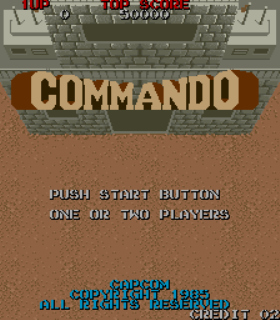
Commando (1985)
By: Capcom Genre: Run 'n' Gun Players: 1 Difficulty: Medium-Hard
Featured Version: Arcade First Day Score: 42,100 (one credit)
Also Available For: Amiga, Atari ST, Commodore 64, Amstrad CPC, ZX Spectrum, BBC Micro, Acorn Electron, Intellivision, Atari 2600
Download For: Wii Virtual Console


If I were to count all of the games on most of the modern consoles by genre, which type do you think would have most examples available? I'm willing to bet it would be first-person shooters, and like all modern genres, these too have their roots in much older games. While it's true that there were some attempts at first-person games as far back as the early 80's, I think that overhead run 'n' gun games have been more influential over first-person shooters than any other genre has. With that in mind, I suppose I can only feature them for so long here at Red Parsley before I come to this particular title, which is a great example of what I'm talking about - it's an FPS, but from above!

To be honest I'm not sure if it's the first game of this type but it was certainly the first popular example. Released by Capcom in 1985, it was an immediate hit and no wonder. It was a new and exciting concept and even tied in with many of the kind of action films that were popular at the time. Like those films, it features little in the way of plot too. It's your familiar 'lone soldier takes on entire army' type scenario with the soldier in question here going by the heroic moniker of Super Joe. The start of the game sees him getting dropped off in an unspecified jungle where he is immediately set upon by waves of hostile enemy troops just waiting to cut him down.

Fortunately, he's suitably equipped to fend them off. His machine gun has unlimited ammo and can be shot in whichever of the eight directions he's facing and he also has a limited cache of grenades which can only be thrown directly up the screen. There are four different stages which are repeated once you've cleansed them of enemy scum who are almost exclusively comprised of generic soldiers. To begin with they are armed with the same weapons as Super Joe but a few later enemies are equipped with rapid-fire RPG launchers. There's also an occasional gun turret, and vehicles like motorbikes and trucks drive across the screen now and then which doesn't make this tough mission any easier!

The trick to succeeding in this game, and indeed many subsequent games, is to keep on the move. The main reason for this is that, inconveniently, the enemy soldiers are infinite. They are also quite often protected or hidden, making them more difficult to take out. They can be found in trenches, bunkers, and watch towers, but wherever they come from, the further into the game you get, the more numerous and accurate they inevitably become. Control over Super Joe is pretty good and his gun, which has a range of less than half the height of the screen, incidentally, is accurate nonetheless. He does, however, have an annoying tendency to get 'stuck' on some scenery.

This is my biggest problem with the game. It can prove very frustrating, resulting in many unfair deaths, and had me gnashing my teeth every few minutes! With some careful play its effect can be minimised somewhat but it's still very annoying. This kind of manic game is hardly the kind that gives you time to be careful, after all! The graphics have understandably dated somewhat too and are very repetitive with very few different enemy designs and the stages, which take in jungles, airfields, and that kind of thing, are samey-looking. The sprites are fairly well drawn though and the choice of colours though the game creates a decent atmosphere. The music isn't bad but can also get a bit repetitive. Chances are, if you're playing the actual arcade version of this, you won't last that long, but you'll at least get to use the cool high-score name-entry a lot! Despite its flaws, Commando is still enjoyable in short bursts, and I guess that's the way it was designed to be played. It's fast-paced, reflex-testing, addictive, and over quickly! It feels wrong to be too harsh on it though. It has aged, more so than some other games of the era, but its immense influence is clear for all to see. I just wish it didn't make me so angry!

RKS Score: 6/10

Special Note: A big thanks to Steve Drysdale for helping me get this pesky game working in MAME. Thanks a lot mate! :)

Sunday, 17 July 2011

Gaming Memories - Part 6

I don't know if it was caused by the admittedly-sizeable expense of new games for my Master System, but one Christmas morning I had a nice surprise. Well, I had a nice surprise most Christmas mornings but on this one in particular I was rather taken aback when I unwrapped a sizeable and fairly heavy gift to find a picture of a ZX Spectrum staring back at me. I'd briefly used other people's computers - my good friend Luke's Dragon 32, a school friend's CPC, but a majority of my experience with computers was at school where they had some BBC Micros. These were I'm sure great computers in their day but they weren't very up-to-date at that time and were hopelessly inadequate for school work. So, aside from a few games of Chuckie Egg and Bomb Jack on my friends computers, my opinion of them was fairly low overall. But then came the Spectrum!

I didn't know it at the time but it soon became apparent that this was no ordinary Spectrum either. As a result of Amstrad's buy-out of Sinclair, they wanted to freshen up the range, so they launched two new models - the Spectrum +2, which had a built-in tape deck, much like Amstrad's CPC 464, and the Spectrum +3, which had a built-in floppy (giggity) disc drive, like Amstrad's CPC 664 and 6128. These discs were a curious format. The biggest problem of being an owner of a Speccy, CPC, or C64 was waiting an eternity for games to load by cassette. I already knew this well before the Christmas gift, and the disc was an ideal solution to this problem. The unfortunate side-effect of this was the inevitable price increase which wasn't helped by the fact that Amstrad had opted for the 3" disc format rather than the already-popular 3.5" ones used by other computers. Needless to say, it was the stylish, jet-black +3 which I received that morning.

Well, I say 'I' but it was actually a joint gift to be shared with my pesky sister (just joking siss!) so it went in a neutral room, but it was, unsurprisingly, I who spent the most time on it. The additional cost of games on disc didn't really matter to me at that point - I was still at school so I didn't have to pay for them, and I could still connect an external tape deck as millions of Speccy fans had done for years anyway. My thoughtful parents had also bought a couple of compilations on this fancy new disc format for us to enjoy, and it came bundled with an Ocean Software compilation which was apparently exclusive to the Dixon's electrical store chain. My experiences with the trusty Speccy would certainly prove to be interesting over the years but, after my dad had spent what seemed like an age tuning it into our portable TV, it was these games that we tried first...

Gift From the Gods (1984)

My dad had taken charge of the situation until we had confirmed everything was working and this was the test game. It's a flick-screen game which sees you in control of a Greek guy who has wings on his boots that let him fly around! After much aimless wandering around from room to room we decided it might be best to consult the instructions. This unfortunately proved to be of little use but subsequent research has revealed that it's an arcade adventure set in an ancient Greek palace called Mycenea and has a fairly detailed story. It's a pretty nice looking game and gave me a good introduction of the kind of graphics I could expect from our new computer, but I didn't get very far. I'm sure it's very enjoyable once you know what you're doing but, despite numerous attempts, I never did.

Cosmic Wartoad (1985)

The next game we tried was this one which is by the same developer (Denton Designs) and is, if anything, even more bizarre and hard to work out. Your job here is apparently to rescue the Queen of the Cosmic Wartoads who has been kidnapped by the evil Slime Beasts, but how this is achieved is something I wasn't able to determine. At its start the game presents you with a grid. Each square here presents you with a single-screen 'challenge' (or at least the few I could access did) where you have to defeat the peculiar inhabitants by shooting them. Success earns you 'Toad Points', failure earns you 'Slime Points'. Predictably I never got very far and didn't return to the game very often despite the fairly pretty graphics once again. I wonder if it was good once it was deciphered?

Daley Thompson's Supertest (1985)

This was more like it! As I'm sure you've guessed, this was one of those notorious joystick and/or keyboard destroyers! I had never played one of these kinds of games before but, unlike the last two, it didn't take me long to work out what to do! It's split into two parts, both of which feature six events including the likes of cycling, ski-jump, tug o' war, diving, and shooting (my favourite). Success in each event required you to waggle the joystick or pound buttons alternately on your keyboard as fast as possible which inevitably resulted in a bent keyboard for my poor old +3. It's great fun though, a multi-event sports sim in the finest style. I soon discovered that there's a good few games like this around but this remained my favourite. My sister even liked this one!

Mailstrom (1986)

Alas, my good fortune didn't last long. Although reasonably well-regarded, this is another one I couldn't work out how to play at the time. It's a 'postman simulator', but with a twist - it's set in a near-future where criminals run rampant! As Postman Nasty, it's your job to ensure the mail gets through, no matter what gets in your way. To do this you need to collect various items to obtain the mail and well as to defend yourself. Looking back, it's quite a novel little game with some good ideas, but thanks once again to the lack of decent instructions with this compilation, I could never get very far. This is probably the least graphically-impressive game on the disc too so I never felt much compulsion to give it another try, sadly...

N.O.M.A.D (1985)

Hooray! This was by far my favourite game on the compilation, my sister's too! It's a shoot 'em up which sees you flying around a flick-screen maze-like structure filled with dangerous defences. I've only recently looked into the story which reveals that this maze is apparently a man-made asteroid which acts as base for an evil intergalactic criminal. Nomad, of course, has been sent as our 'last hope' of infiltrating the base and stopping the dastardly crook in his tracks. It's a pretty big game set over four sections and there are some creative features found within too. Nomad himself, an attack droid, is a little cumbersome to move around which can make the game's later stages rather tricky, but this is still an addictive and very enjoyable game which I continue to play today, now and then.


So, as my introduction to home computer gaming, this compilation was something of a mixed bag. Nomad and Supertest were both great fun and remain so today but the others? Looking into it, it seems they all got at least reasonable reviews in magazines of the day. Was my inability to suss them out a result of my own stupidity? It's certainly possible but lets not forget - up until this point, the only games I'd really played were arcade or arcade-style games, both in their native habitat as well as on my splendid Master System. The fact that the compilation came with practically nothing in the way of instructions certainly didn't help matters!

Oh well, like I said, my parents had also bought a couple more compilations for my sister and I to play, including the immensely awesome Magnificent Seven and Giants, and the Speccy soon became a treasured and much used system. My sister gradually lost interest in it so I was able to move it up to my bedroom (sweet!) and my collection of games was increased frequently. The fantastic budget games sold by my local video rental store were a frequent source of my attention and my dad very helpfully bought all three of the main Speccy mags - Sinclair User, Your Sinclair, and Crash - and the cover-tapes they regularly featured were an invaluable resource. I even got a Multiface 3 the next Christmas which allowed me to see the end of games I had gotten stuck on!

As I mentioned in my 'Exploring the Commodore 64' feature, it's easy to see the appeal of the Speccy's competitors. I'm sure I would've had a similarly happy time with one of those if I'd been given one, and I'd have the same warm, nostalgic memories of that system now instead, but the Speccy it was, and it's a system I still have an enormous amount of affection for...

Special Note: Thanks to Stiggy for the Speccy pic which I borrowed from him without realising! Check out his great blog here :)

Thursday, 14 July 2011

Top Five Iconic Race Cars

Some people go absolutely crazy over motorsport, spending hundreds of pounds (or whatever currency they use) to travel around their country, even the world, following their favourite cars or drivers. I'm only what you'd call a casual fan myself, but even if you have no interest in the sport whatsoever, there are certain cars that stick in your mind. It may be through their glory on the track that they become well known to you, it may simply be for a distinctive colour-scheme. The reason isn't enormously important I suppose, but as far as I'm concerned, these are the five racing cars that I consider to be the most iconic:

5 - Ford GT40 (1964 - 1969)

This one is from before my time so it says a lot that it's such a familiar sight to me. It was designed by Ford for the express purpose of ending Ferrari's dominance at the Le Mans 24 Hour race. This determination supposedly stemmed from Ford's attempt to buy Ferrari in the early 60's; an attempt which Enzo Ferrari ended at the last minute, wasting millions of Ford's dollars. Whatever the reason, it was a mightily impressive car! The GT40, so called as the roof lies a mere 40 inches from the ground, was certainly very distinctive in appearance, especially with the colour scheme below. It went through several iterations during its lifetime. Being American, all of them did of course come with a monstrous V8 engine, and all of them were successful too. By the time it was retired in '69 it had won the Le Mans race four years in a row...


4 - Lancia Delta HF Integrale (1979 - 1994)

Like many I suspect, a majority of my sightings of this car have come as a result of playing a certain rally game by Sega! The eye-catching Martini livery is certainly memorable, both in the game and in real life, but it's definitely not the only noteworthy thing about this great car. The road version of the Delta wasn't anything special but Lancia are second only to Citröen for World Rally Championship wins and that is mostly thanks to various versions of the Delta. In fact, a new version of the Delta was introduced in 2008 so perhaps we'll see that Martini colour scheme again soon. Maybe it can even end the current dominance of Citröen...


3 - Porsche 962 (1984 - 1991)

Developed as a replacement for the 956 which had just been banned for safety reasons, the 962 was a sports-prototype created for competitions like the Le Mans 24 Hour race. It was immediately successful and took over Porsche's amazing run at Le Mans by winning the competition for their sixth and seventh successive years. There are many versions of it run by many companies but it's always been the red and yellow Shell car that has stuck in my mind. Whatever colours it's racing in, though, it has proved a remarkably long-lived car, continuing to race successfully years after production of it ended. Some creative (and rich) enthusiasts have even adapted it for road use!


2 - Subaru Impreza WRX (1992 - Present)

The Impreza is well known for many reasons. Along with Mitsubishi's Evo cars, it has proved popular among boy-racers as a reasonably affordable sports saloon, and a lot of power can be wrung from its flat-4 Boxer engine. In fact, the popularity of its various road versions have almost eclipsed what made it famous to start with. That is, once again, the World Rally Championship! It may not be among the most successful rally cars of all-time but its lovely blue colour along with the gold Subaru logo emblazoned along its sides, along with the comparative lack of sponsors plastered all over it, do help to make it one of the most distinctive. The design is so popular it can even be found on many of the road-going versions.


1 - McLaren MP4/1-11 (1989 - 90)

Yes, there's been lots of memorable and distinctive looking Formula 1 cars - the black and gold Lotus, the multi-coloured Benettons, the Rothman's Williams, but for many years when I was younger, the design of this McLaren was F1! Of course I didn't realise it at the time but it turns out the colours are that of Malboro cigarettes rather than anything specific to McLaren, but they carried the colours for a good few years and on many of their cars, from the first car of the range - the MP4/1, right up until the MP4/11. McLaren enjoyed one of the most successful runs in their history while sporting the Marlboro design too. I'm sure it didn't hurt that they had some rather famous drivers too, in the form of Ayrton Senna, Alain Prost, and Gerhard Berger, so the design certainly got a lot of exposure. I remember being sad when it was replaced - I initially thought that McLaren had pulled out of F1 altogether. "Where's the red and white cars?" I cried! It turned out that they were now a rather less appealing grey and black after ending their 23-year long association with one cigarette company, replacing them with another, but then I discovered the colours once again, being used by Penske Racing, an Indycar team in the US! It wasn't the same though, and I miss the red and white McLarens...